|
Ellen
White - prophet?
Earth
after Second coming
The image, beasts of Daniel and "Revelation" Whore of
Babylon New
or Restored Jerusalem? The
Judgment Who
was Jesus before He came first time? Why
Sacrifices?
Seal of God and Mark of the Beast The
Book of Life What
happens when we die?
|
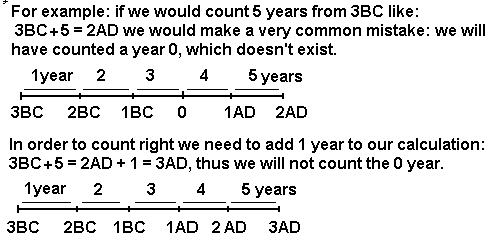
How to count years from BC to AD. |
|
Without understanding of
Daniel's prophecies it is impossible to comprehend any prophecy about our
future. There is a huge misunderstanding of the 70 weeks prophecy , therefore we
should begin from it. “Seventy weeks are determined upon thy people and upon thy holy city, to finish the transgression, and to make an end of sins, and to make reconciliation for iniquity, and to bring in everlasting righteousness, and to seal up the vision and prophecy, and to anoint the most Holy. Know therefore and understand, that from the going forth of the commandment to restore and to build Jerusalem unto the Messiah the Prince shall be seven weeks, and threescore and two weeks: the street shall be built again, and the wall, even in troublous times” (Dan.9:24,25) At first we need to found a time point of readout of the prophecy about 70 weeks (Dan.9:24-27), i.е. when the commandment to rebuild the city of Jerusalem was given. The
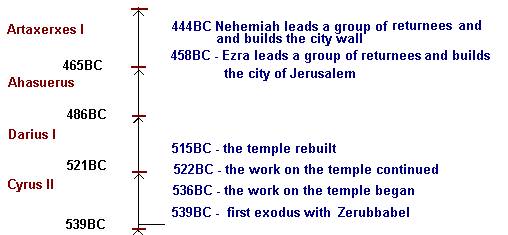
historians agree that in 539BC Cyrus of Persia defeated the Babylonian Empire
and allowed Jews to return to their homelands. Zerubbabel led the first group of
returning Israelites in 538BC and started to rebuild the temple. The work on
restoration of the temple was completed in the sixth year of Darius I in 515 BC. Nehemiah led the third group in
444BC and built the wall around of the already rebuilt city of Jerusalem (the
data is |
|
You will see that your Bible clear says: the statement above is wrong. First. Adventist church, as many others, teaches that the commandment to restore Jerusalem was received by Ezra in the 7th year of the government of Artaxerxes I in 457BC. From this year, despite of the principle of the prophetical time (p. 2), the church begins to count 69 weeks as 483 years (we will discuss the 69 weeks later) and comes to 27AD the year when supposedly Jesus was baptized (457BC-483+1=27AD).
However 27AD doesn't have a proper base. Luke clearly said (3:1-2) that John
Baptist began his ministry in the 15th year of the reign of Tiberius Caesar.
Tiberius became Caesar in 14AD, thus his 15-th year was 29AD.
That means Jesus could be baptized not earlier than 29AD. Bible said,
that John the Baptist began his ministry in 29AD, it doesn’t say that Jesus
was baptized in the same year - 29AD. In
fact, when Jesus came to Jordan to be baptized,
John already was well known by “Jerusalem,
and all Judaea, and all the region round about Jordan”
(Mat.3:5: Mark 1:5), so it’s more likely that he was preaching more than a
couple months (nobody knows, which day Luke was counting as a beginning of the
year. At that time several calendars were aligned to start on the
birthday of Augustus, 23 September http://en.wikipedia.org/wiki/Julian_year_(calendar) Adventists teach that 27AD
was the fifteenth year of Tiberius’ principality: for he was two years joint
emperor, previously to the death of Augustus, thus they teach 15th year of his government was in fact 27AD. Nevertheless an attentive study of the time of the
government of Augustus will clearly show the short time (less than 2 years),
when Tiberius was openly recognized by Augustus
as his successor and was allowed to Senate was not actually the time of
his co-governing: he did not issue laws and did not incur any responsibility for
the empire. Tiberius wasn't a leader, he couldn't speak neither to the people, nor to Senate. Augustus had approached him to himself because Tiberius wasn't a competitor for him, the emperor didn't afraid that Tiberius would withdraw the respect of Augustus' subjects to himself. Until his death Augustus had remained in good mind and memory, in the year of his death he had recorded all his victories, which he had achieved during his life ("The Deeds of the Divine Augustus"). August had no needs for assistants. Being
the selfish and proud governor, who had realized well his merits in the
strengthening of the empire, it was pleasant to him, when the people had seen
the contrast between him, the old, but the wise leader and bright person, and
the future governor, the savage, recluse and suspicious man as Tiberius was.
Nobody perceived Tiberius as the governor of the empire at that time. The Cesar’s successor, not by blood but by Cesar’s own choice, Augustus completely satisfied expectations of Roman people. As the first Roman emperor he organized provincial government and the army, rebuilt Rome, and patronized the arts and letters. His rule began a long period (200 years) of peace and prosperity, called the Pax Augustus (or Pax Romana). What he had done for empire was so great that it seemed impossible for a human to do that, therefore many considered him as god and worshipped him even after his death. During the time when Augustus was alive, Tiberius was only a shadow of the leader, the Senate, and especially masses never perceived him as a governor of the empire, while August was alive. Luke could not attribute to Tiberius' government the last 2 years of Augustus by any means. That is why 29-th AD, not 27-th was the year, when John the Baptist began to preach, and Jesus could come to him in 29 AD or later. http://classics.mit.edu/Augustus/deeds.html Second: there is not logical sequences of events in the traditional explanation of the prophecy. See by yourself: the temple was built, then the city of Jerusalem, then the city wall. From the mentioned books we know, how many enemies, who tried to prevent Jews from rebuilding the temple, the Jews had around. Their neighbor nations were dangerous for the Jews. There was no way for the Jews to rebuild the temple and the city without rebuilding the city wall first. The city wall had no an esthetic propose but the defensive one. It had to be rebuild first. Now, lets work with these books step by step. From
history we know, that in 539BC Cyrus II (559-521BC) conquered Babylon and gave
the commandment to rebuilt the temple (Ezra 1:1-3). At Cyrus’ government, in
539-538 BC, the first Jews went from their captivity to Jerusalem and It was Sheshbazzar, not Zerubbabel, who had received silver and gold from Cyrus (Ezra 1:8). The name of Sheshbazzar wasn’t mentioned in the list of people, who came with Zerubbabel, because Sheshbazzar led another group of, the very first one. The
second exodus occurred later with Zerubbabel (Ezra 2:2), the governor
(Hag.1:14). When they came and began to build the city of Jerusalem the neighbor
nations wrote the letter to king Artaxerxes I with a complaint on Jews, they
said in it: ““Be it known unto the king, that the
Jews which came up from thee to us are come unto Jerusalem, building the
rebellious and the bad city, and have
set up the walls thereof, and joined the
foundations” (Ezra 4:12). Nehemiah
(or Tirshatha 1:1;10:1) was a very rich and respectful person (Neh.7:70). At
first he came to Jerusalem with Zerubbabel’s group (Neh.7:7; Ezra 2:2) and
together with priest Ezra he participated in the Feast of tabernacles
(Neh.8:9,17), which they didn’t have “since the days of Jeshua the son of Nun”
(Neh.8:1,17). The feast was held in seventh month (Ezra 3:4,6) in the first year of
Zerubbabel’s return to Jerusalem (Ezra 3:6,8). After that Nehemiah return to
Babylon to continue his work as the Artaxerxes’s I In about 10 years later (we will discuss this time period later) when he was in Shushan (Neh.1:1 indicates that Nehemiah wasn’t staying in one place all these years), he heard that people who went to Jerusalem are “in great affliction and reproach; the wall of Jerusalem also is broken down, and the gates thereof are burned with fire” (Neh.1:3). Nehemiah was very upset (1:3), because he was with Zerubabel’ people, when they fixed the walls. It were probably neighbor tribes, who were against rebuilding of Jerusalem and who burned the gates. In the 20th year of the reign of the king Artaxerxes I (ruled from 465 to 424BC) Nehemiah asked the king the permission to go to the city of his forefathers and built it. The king sent Nehemiah to build the city (Neh.2:1,5,6) and gave him a wood for building the city wall and gates of Jerusalem (2:8). Nehemiah didn’t say that it was the commandment to rebuilt the city, more likely it was just an answer to his request. “In
the day that thy walls are to be built, in that day The wall was built despite
of all troubles (Neh.4:16,17), Nehemiah
said: “Ye see the distress that we are in, how Jerusalem lieth waste, and the gates thereof are burned with fire: come, and let us
build up the wall of Jerusalem, that we be no more a reproach” (2:17).
Thus, Jerusalem was empty until the wall was built. In the time of Nehemiah Jerusalem “was large and great: but the people were few therein, and the houses were not builded” (Neh.7:4). The commandment to rebuild Jerusalem was given by Nehemiah as the governor (Neh.5:14) when city walls were built. Thus the commandment to rebuild the city of Jerusalem was given by Nehemiah in the same 20th year of the reign of the king Artaxerxes I, in 446BC. If it would be Ezra, who received the commandment to rebuilt Jerusalem 14 years before Nehemiah’s time (as it accepted in today’s teaching), there would be some houses already built in the city. The wrong conclusion that Nehemiah's time was after the time of Ezra and
the city and the temple were already rebuilt before Nehemiah came , probably was
made because Bible tells that there was the temple of God in Jerusalem in the
time of Nehemiah (Neh.6:10). However, in that time even
the place where the temple was before was called the house of God. Ezra said : “ Now in the second year of their coming unto the house of God at Jerusalem, in the second month, began Zerubbabel .. and Jeshua .. and the remnant of their brethren the priests and the Levites.. to set forward the work of the house of the LORD… the foundation of the house of the LORD was laid” (3:8,11). Thus the place was called house of God even when the house did not have a foundation. There was no temple of God in Jerusalem in Nehemiah’s time. Bible says that Artaxerxes I stopped all work on the temple, and the work had not continue until the 2nd year of the government of Darius (Ezra 4:24). If the temple was already built when Nehemiah came to Jerusalem, then how he would stop the work on the temple?
Besides of the Artaxerxes’ commandment to stop the works on the temple Ezra mentioned a help of Artaxerxes I in rebuilding of the temple (Ezra 6:14) also. It lead to the confusion: did he stop rebuilding or did he help with that? The king stopped the work on the temple, but allowed Nehemiah to built the courts of the house of God (Neh. 2:8 “the palace of the temple”; 13:7). It was a fortress inside of the place of the temple, where the altar was, called the house of God. The temple was not built yet.
The temple was restored when all people of Jerusalem already had their
own houses (Hagg.1:4,9), but in
In
the chapter 4 Ezra described the troubles of the rebuilding of the temple the
Jews went through from the beginning of the exodus from Babylon until the time
of Ezra. The Jews had a strong opposition from their neighbors (Ezra 4:5): “all the days of Cyrus (Cyrus II from the exit out of Babylon in 538BC till 521BC)… even until the reign of Darius (Darius I 521-486BC)”. At
the reign of son of Darius I – Ahasuerus (486-465BC) there was the accusation
against Jews (Ezra 4:6), it happened in the same time when the king gave the
order to cause to perish all Jews in After that Artaxerxes (Artaxerxes I 465-424BC) stopped all works on the temple, and the work was “ceased undo the second year of the reign of Darius” (Ezra 4:7,21,24). This was Darius II, he reigned from 424 until 404BC.
Thus, in the second year of the government of Darius II (Ezra 5:5)
in 423BC “the
Lord stirred up the spirit of Zerubbabel…and the spirit of Josua …and they
came and did the work in the house of the Lord….in the second year of Darius
the king” (Haggai 1:14-15). Zechariah (4:9) said : “The
hands of Zerubbabel have laid the foundation of this house; his hands shall also
finish it” (The Jews actually considered that Zerubbabel not
Sheshbazzar had laid the foundation of the temple, because it was almost nothing
left from the first foundation and it wasn't even finished: “since
that time even until now hath it been in building and yet it is not finished”
(Ezra 5:16). As
we see, if Zerubbabel would come to Jerusalem in 538BC, as it is accepted to
consider today, in the times of Darius II, after 116 years, he, certainly, would
be dead already. |

|
You see the historians agree, that the temple was rebuilt in the government of Darius, but they are claming it to be in the government of Darius I thus they overlooked all the kings mentioned by Ezra as the kings in which reign the temple had been under the reconstruction.
After describing all details of rebuilding of the temple Ezra continued: “Now after these things, in the reign of Artaxerxes” (Ezra 7:1)...
This was already Artaxerxes II (404-358BC), who governed after Darius II. “In the seventh year of his government” (Ezra 7:8,9), which was 398BC,
the mass exodus from Babylon occurred.
At that time Jerusalem became safe to live in, the city walls and houses were built, the temple was built and Jews found the favor in king’s eyes. That exodus was lead by Ezra, who was not the same priest Ezra of Zerubbabel’s and Nehemiah’s time. He was the son of Seraiah (Ezra 7;1) the priest, who came in Jerusalem earlier with Zerubbabel (Nehemiah 12:1). Ezra was a skilled scribe and the king gave him gold and silver to buy for that animals, grain and drink for the offerings for the altar of the house of the Lord (Ezra 7:17).
Bible
is telling us that Ezra gave the gold to Meremoth the son of Uriah the priest
(Ez.8:33). Nehemiah twice has named Meremoth the son of Uriah (Neh.3:4,21), at
listing of the people, who built the city wall. He attentively has specified
their ranks, but he told nothing about a rank of Meremoth. Why? Because in
Nehemiah’s time Meremoth was just
a young man and he didn’t have a priest rank yet. It means, that Nehemiah’s
time was before Ezra’s time. Nehemiah in 12:47 indicates that after the time of Zerubbabel the Nehemiah’s time (not Ezra’s time) was, and priest Ezra (the first priest, not the author of the book) was governing together with Nehemiah (Neh.12:26). In the time of Nehemiah when neighbors heard that the Jews were building the wall, they got worrying: “will they sacrifice?” they asked (Neh.4:2). Though Zerubbabel’s people offered burnt offerings to the Lord, they were doing it quietly, because “fear was upon them because of the people of those countries” (Ezra 3:3). At the
time of Ezra the wall was already build, therefore Jews felt more safely,
and the people around
The traditional understanding of the books of Ezra and Nehemiah: |
|
Bible
clearly says that Nehemiah came with Zerubbabel returnees at first (Neh.7:7;
Nehemiah describes the first exodus with Zerubbabel from 7:6 to 12:21); that in the time of Nehemiah’s government the
Zerubbabel’s people were around of him (Neh.12:26). If he would come first in
539BC as a rich and respectful person (Neh.7:65,70;
Bible says, that with Zerubbabel Jeshua the son of Jozadak came (Ezra 5:2), who
was the high priest (Hag.1:14). They came in the time of the reigning of
Artaxerxes I (as it was shown above). As we know, Jeshua began to rebuilt the temple when Darius II allowed to rebuild it in 423BC (Hag.1:14, Bible does not say that Jeshua was still alive when the temple was finished), therefore the time between his coming to Jerusalem and 423BC can not be very long. By
comparing all evidences we can assume that Jeshua came to Jerusalem with
Zerubbabel about 10 years earlier than Nehemiah (apr. in 456BC) and was about 60
years old, his first son Joakim was about 40 years old and the son of Joakim -
Eliashib was about 20 or older. Approximately 10 years after Zerubbabel’s
coming Nehemiah returned to Jerusalem already as the governor. In the time of
Nehemiah Eliashib was 30-40 years old and was already the high priest
(Neh.3:1;13:4). When Ezra came, he stopped for the night in the house of
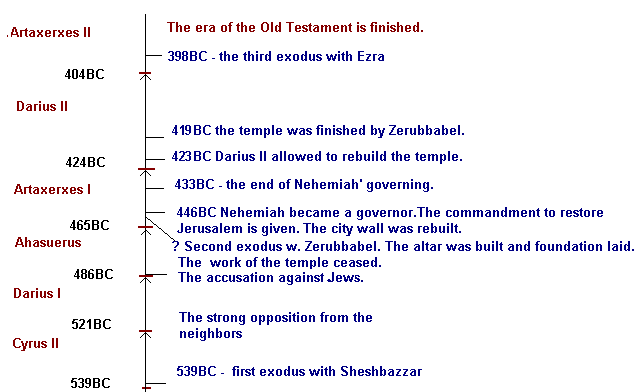
Jehohanan (Ezra 10:6), who was the grandson of Eliashib (Neh.12:10-11). So the events described in the books of Nehemiah and Ezra are given in the following order: |
|
Thus, we got the three dates which we will need later: From
that point on God turned away His face from Jews. He didn’t speak to
anyone anymore. There were not prophets anymore (see last prophets of Old
Testament in the Bible). Zechariah (1:1) and Haggai (1:15) were the prophets in
the time of rebuilding of the temple, in the government of Darius II. When the
prophet Malachi (perhaps it is not a real name, the word "malachi"
means: "My Messenger") was prophesying it is not known, but many
historians agree that he was the prophet in the time of Nehemiah, because there
are numerous ties in the book to the concerns of Nehemiah (These include
marriages with foreign women (Neh.13:23-27), not paying tithes (Neh.13:10-14),
neglecting the Sabbath (Neh.13:15-22), a corrupt priesthood (Neh.13:7-9), and
injustice (Neh.5:1-13)). 419BC is also important date. Without the understanding of the time of rebuilding of the temple we couldn’t see many things including the date of the issue of the commandment to rebuilt Jerusalem. Also we could not know, when there was an exodus leaded by Ezra, which is also significant for understanding of the prophecy. God sealed the actual date of rebuilding of the temple until the last time: “for the words are closed up and sealed till the time of the end” (Dan.12:9). Our time is the time of the end as we will see it later, and God is opening it for us today. Thus, the decree about restoration of Jerusalem was given not by Artaxerxes I in 457 BC, as Adventists teach, but by Nehemiah in 446BC, and the Daniel's 70 weeks prophecy has to be counted not from 457BC, but from 446 BC. |